The ROI of Hiring for Heart: How Values-Based Recruitment Drives Performance
Published: Friday, February 27, 2026

Executive Summary
In an increasingly competitive talent market, the biggest challenge for organizations is not finding people with the right skills, but finding people whose values, behavior, and leadership styles are aligned with the organization’s purpose and culture. Research shows that a majority of hiring failures can be attributed to misalignment rather than lack of skills. For credit unions — mission-driven organizations where culture directly impacts member experience — this problem is especially acute.
This white paper introduces a practical framework titled Hiring for Heart, which helps leaders systematically design hiring processes to assess cultural alignment, leadership behaviors, and environmental fit. When applied consistently, this approach reduces turnover, strengthens engagement, and enhances performance.
The Evolving Hiring Landscape
Hiring today looks very different than it did even a few years ago. Several key shifts have reshaped how organizations recruit and retain talent:
- Candidate expectations have shifted. Workers today place higher value on organizational purpose, flexibility, and growth opportunities.
- Competition for experienced talent is fierce. Organizations now compete across industries for individuals with strategic and technical competence.
- Greater performance risk. A poor hire now impacts not just operations, but engagement, culture, and member or customer experience.
- Leadership hires are made under more pressure. Growing organizations must fill critical roles quickly, increasing the risk of misalignment.
For mission-oriented organizations such as credit unions, a misaligned hire can reverberate beyond internal teams and affect external member trust and service quality.
The Hidden Cost of Misaligned Hiring
Most organizations do not lack access to capable candidates. The real issue is identifying those who will thrive within the organization’s values and culture.
A misaligned hire often results in:
- Higher turnover and rehiring costs
- Lower employee engagement
- Team instability and performance drag
- Leadership friction
- Cultural dilution affecting service and outcomes
These impacts are often felt long before they appear in formal metrics, which makes them hard to diagnose but costly in aggregate.
What the Research Says
Multiple studies and industry observations underscore the importance of alignment between individuals and organizations:

- Research referenced in Harvard Business Review suggests that up to 80% of employee turnover is tied to hiring decisions that did not adequately assess cultural and values alignment, rather than lack of skills. 1
- Data from the Society for Human Resource Management (SHRM) confirms that employees who experience positive workplace culture are significantly more likely to stay, supporting the link between culture and retention. 2
- Academic literature on person-organization fit shows that alignment with organizational values often predicts successful long-term employment better than job-specific skills alone. 3
In summary: Hiring decisions that prioritize technical skills over cultural and behavioral alignment often result in lower retention and performance outcomes.
The Real Challenge: Alignment, Not Talent
When hiring processes emphasize skills and experience without intentionally assessing alignment, organizations inadvertently increase risk. Common breakdowns include:
- Role clarity lacks behavioral expectations. Job descriptions focus primarily on duties and skills, not on what success looks like behaviorally.
- Interviews rely on hypothetical or résumé-driven questions. These approaches do not reveal how candidates have behaved in real situations.
- Urgency overrides intentionality. Pressure to fill roles quickly leads to decisions that compromise long-term fit.
These issues occur across industries and organizational sizes but are especially consequential in mission-driven environments.
The Hiring for Heart Framework
To address misalignment, successful organizations adopt structured, intentional hiring processes that evaluate candidates along three critical dimensions:

Values Alignment
Values alignment answers the question, “Does this person’s internal compass match ours?” It focuses on behavior not beliefs or affinity. Leaders can assess this by asking for examples of past behavior that illustrate how candidates lived out values in real work situations.
Leadership & Behavioral Fit
Leadership behavior fit examines how a candidate leads, influences, and collaborates. Two leaders with similar skills can deliver very different outcomes if their behavior styles differ. Structured behavioral questions here help differentiate candidates beyond surface competence.
Role & Environment Readiness
Even highly capable leaders may struggle in environments where pace, autonomy, structure, or organizational maturity differ from their experience. Assessing environmental fit helps ensure candidates are likely to succeed in the organization’s actual context, not just in theory.
How Leaders Can Apply the Framework
Transforming theory into practice requires concrete changes to how organizations approach hiring. Here are actionable steps:
Step 1: Clarify Values in Action
Organizations should define not just what values are, but how they manifest in behavior. For example:
- What does “member focus” look like in decision-making or conflict resolution?
- What behaviors demonstrate accountability?
Clear behavioral definitions make subsequent assessment more reliable.
Step 2: Improve Interview Quality
Replace hypothetical questions with behavior-based inquiries that uncover evidence of past performance. For example:
Scenario: Conflict
- Good: “How would you handle team conflict?”
- Better: “Tell me about a time you addressed conflict within your team. What happened, and what was the result?”
Scenario: Decision-Making
- Good: “How do you make decisions?”
- Better: “Describe a difficult decision you made with limited information. What did you consider, and what was the outcome?”
Scenario: Accountability
- Good: “How do you hold people accountable?”
- Better: “Tell me about a time you coached someone through performance issues. How did you approach it, and what changed?”
Behavior-based questions generate evidence, not opinions.
Step 3: Align Leadership Early
Before a search begins, leaders should agree internally on:
- What success looks like
- Core values that matter most
- Leadership behaviors essential for the role
- Environmental conditions the candidate must navigate
This alignment streamlines evaluation and reduces inconsistent decision-making.

When Support Matters Most
Internal teams are capable and often well positioned to manage most recruitment. External support becomes most valuable when:
- The role is high-impact (executive or culture-shaping)
- Internal capacity is limited
- Leadership needs facilitation to reach consensus
- The organization is undergoing change or growth
A strategic partner can help structure alignment assessments, facilitate calibration discussions, and reduce blind spots — enhancing decision confidence without replacing internal ownership.
Conclusion: Hiring as Strategy
Hiring for heart is not an HR checkbox, it is a leadership strategy. Intentional alignment in hiring strengthens culture, improves retention, and enhances performance. For credit unions and other mission-driven organizations, this strategy fuels both internal strength and external impact.
Final Question for Leaders
Does your hiring process reflect the culture you’re trying to build or just the roles you’re trying to fill?
When hiring reflects values, performance follows.
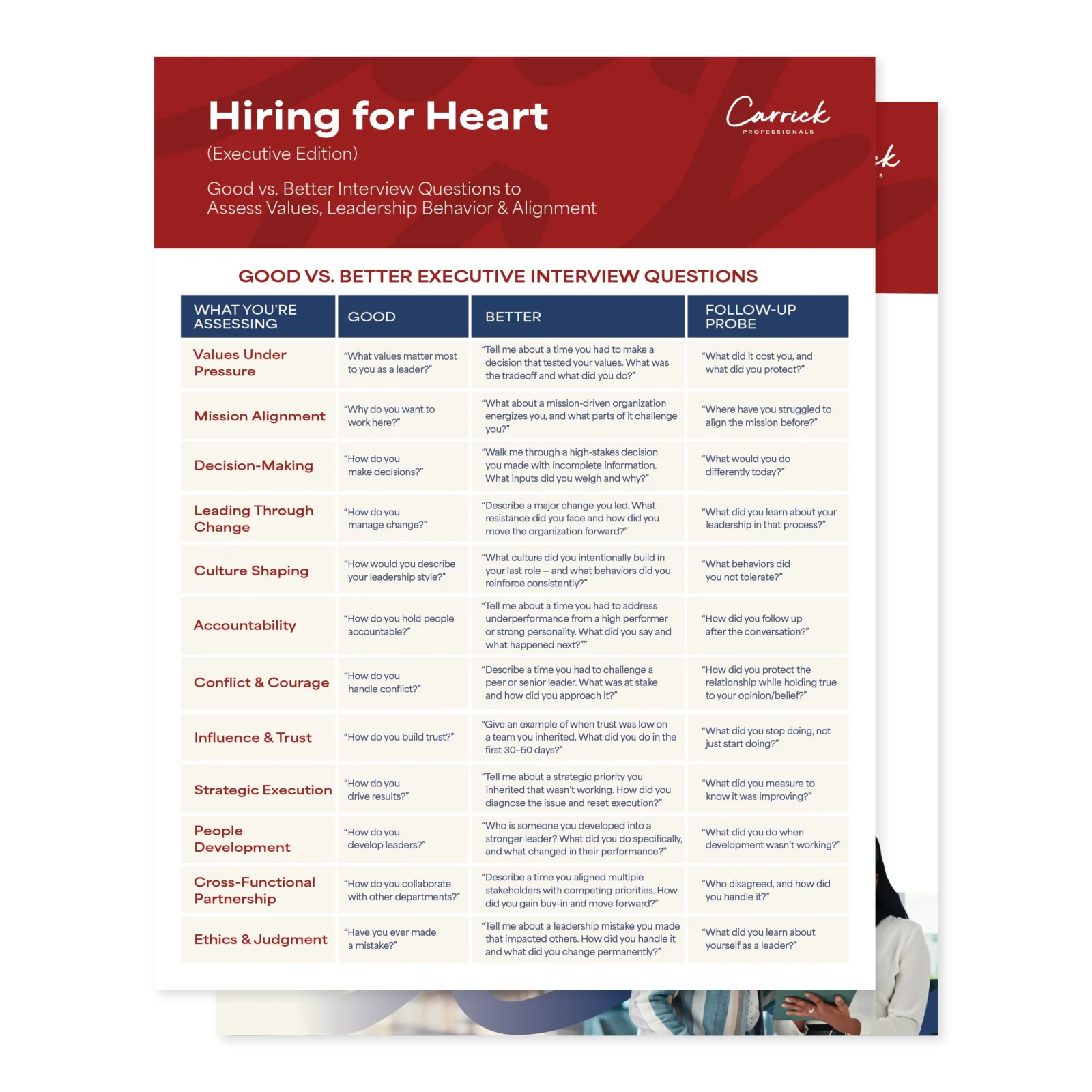
Get the Step-by-Step Guide
From interview questions to a value assessment, our step-by-step guide will help you put this framework into practice.
To access the guide, select “Talent Solutions” in the form below and include “Guide” in your message.
Sources
1 Research referenced in Harvard Business Review on turnover and hiring outcomes (as summarized in practitioner reporting).
2 Society for Human Resource Management (SHRM) research on culture and retention.
3 Academic research on person-organization fit and hiring outcomes.

Taylor Eblen, SHRM-SCP, leads the strategy and delivery of Carrick Talent Solutions, partnering with credit unions and mission-driven organizations to solve talent, leadership, and alignment challenges through values-based recruitment and strategic HR consulting.
Connect with Taylor and explore Carrick’s service offerings at GoWithCarrick.com.